
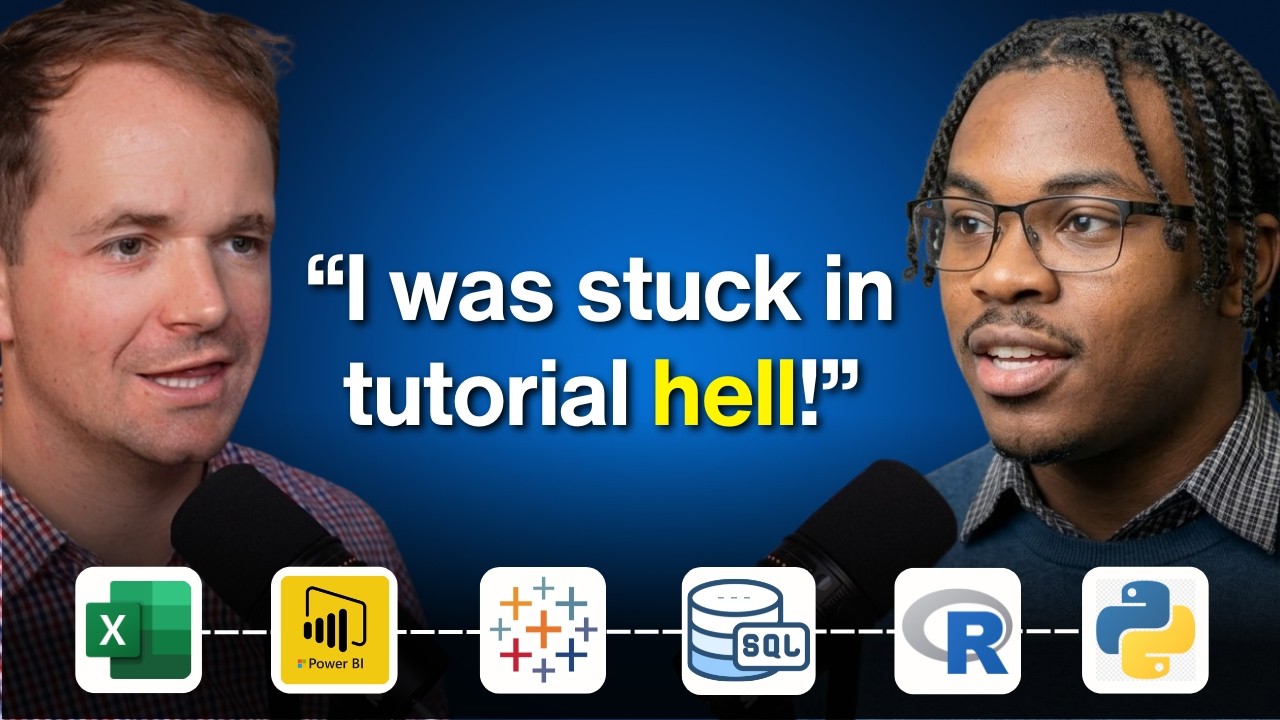
I'll say it: Stop learning R and Python.
Trying to learn data online can feel like standing in the middle of a loud market.
Everyone is shouting a different tool at you.
"You have to learn Python."
"Actually, R is much easier."
"Power BI is the future."
"Power BI is ugly, use Tableau."
"Wait, AI is taking over, just use ChatGPT."
And if you are new, it all sounds important. So you try to learn all of it.
That was Kam Hall before he got his first data job.
Kam spent five years working retail at Home Depot. He had a sports management degree, was in grad school for IT, and had no data experience.
Three months after joining my bootcamp, he had a job offer.
Here is what actually got him there.
The Easy Way To Stay Stuck
Before Kam joined the Data Analytics Accelerator, he was doing what most beginners do.
He was on Udemy. Watching videos. Trying to learn SQL. Then jumping to Python. Then wondering if he needed a database certification too.
He did not even know which data role he wanted. So every tool felt urgent. Every post online made the list longer. That is how tutorial hell works.
You feel busy because you are always learning. But when you look back, you have not built much. You have not applied much. You do not have proof that someone can trust you with the work.
What broke the cycle
When Kam joined the program, the first thing that changed was structure.
We gave him a clear path to follow. He had a study plan. He knew what to focus on. He knew what to build. He did not have to wake up every day wondering what to focus on.
That matters more than people think.
Kam started in June. By September, he had a job offer.
But structure only helped because Kam used it to build proof and take action.
Stop Applying Like Everyone Else
Most people apply and wait. Kam applied and reached out.
After each application, he looked for a recruiter or HR person connected to that team. Then he messaged them the same day or the next morning. He was applying to 15 companies a day and personally reaching out to 15 people a day.
He said it best himself: just applying feels like going through a drive-through. Someone hands you your food and that's it. There's nothing personal about it.
Reaching out changes that.
When he applied to InComm Payments, the company that eventually hired him, he messaged someone on their hiring team. That person wasn't in charge of the intern program, but they pointed him to the right contact.
That one message led to his first interview the next Tuesday.
One week from application to interview, because he made it personal.
Why He Didn't Get A Coding Test
Kam expected the interview to be technical. It was not.
Both of his interviews were just conversations. No SQL tests. No Python problems. Just conversations about who he was, how he thought, and whether he would fit the team.
But there's a reason it went that way.
Kam had a portfolio.
When you show up with portfolio projects, the hiring manager already knows you can do the work. You've answered the technical question before the interview even starts. So instead of testing you, they spend the time getting to know you.
Many first data analyst interviews work like this. A portfolio doesn't just prove your skills. It changes the entire conversation.
The Truth About Data Analyst Tools
Now Kam works as an inventory analyst. And one of the biggest surprises from his first year was how normal the tools were.
A lot of Excel. Some SQL. Internal systems. Some AI. And a lot of business knowledge.
That last part is important.
Kam said technical skills are easier to pick up when you understand the business.
That is the real job. Learning what the company does, what the team cares about, and how data helps people make better choices.
Kam is learning Python now, but only after landing the job and getting real experience. He says working in Excel at a real company made the logic of Python easier to understand anyway.
How To Land Your First Data Job
Getting your first data job isn't about becoming the most technical person in the room.
It is about becoming someone a team can trust.
And trust comes from a few simple things.
A clear path, so you stop jumping between random tools.
Proof, so hiring managers can see what you can do.
Outreach, so you are not just another resume in the system.
Communication, so people understand your thinking.
Business sense, so your work actually helps the team.
That is the better path.
First get going. Then get good.
P.S. Inside the Data Analytics Accelerator, Kam got the structure, projects, and job search support that helped him go from stuck to hired in about 12 weeks. If you want the same, we're enrolling now.