
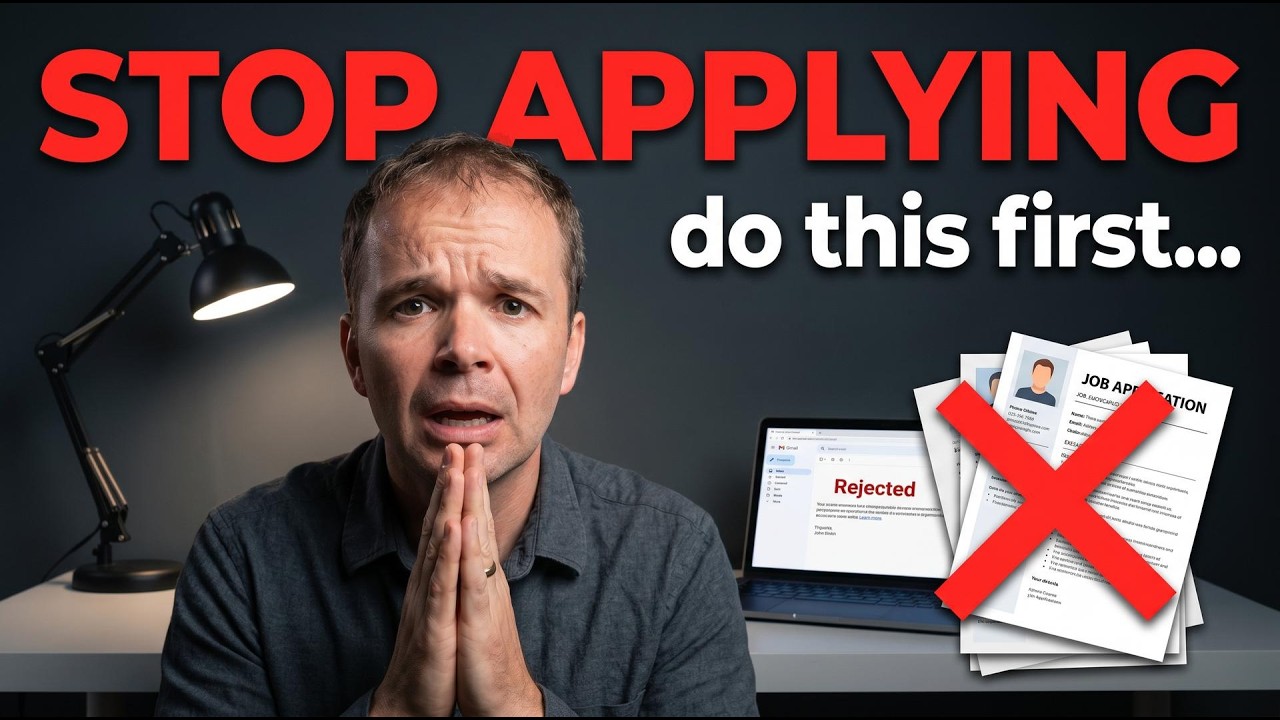
I'm Begging You to Stop Applying to Data Analyst Jobs
I am begging you.
Before you send another data analyst job application, please do one thing first.
Run the mirror test.
To understand why it matters, you have to see the job search from the hiring manager's side.
Hiring is scary for companies. Think about it.
A hiring manager is about to trust a stranger from the internet with a salary, company data, internal meetings, and a spot on the team.
If they make the wrong hire, it can take 6 to 12 months to fix. It can waste budget, slow the team down, hurt their reputation, and make everyone's work harder.
So when they open your resume, they are not looking for reasons to say yes.
They are looking for any reason to say no.
A recruiter or hiring manager may only give you 6 to 10 seconds at first. In that short time, your resume, LinkedIn, and portfolio need to answer one simple question:
Can I trust this person enough to keep reading?
That is where the mirror test comes in.
The mirror test means looking at your resume, LinkedIn, and portfolio like you have never met yourself before. Pretend you are a tired hiring manager with 300 resumes to scan and no time to guess.
Then ask yourself: Would I keep reading? Or would I move on?
Here are the three places to check. You can do all three in about 30 minutes.
1. Your Resume Has To Pass Two Tests
Your resume is your most important job search asset. But here's the part many people miss: a human may not read it first.
A lot of resumes look nice to humans, but they break inside an Applicant Tracking System, or ATS. This is the software companies use to scan resumes before a human sees them.
If your resume has two columns, sidebars, tables, icons, or weird formatting, the system may read it badly. That means your best skills could be hidden before you ever get a chance.
So first, run your resume through an ATS checker.
Then do the 6-second test.
Open your resume on your phone. Look at it for 6 seconds. Then close it. What do you remember?
If "data analyst" didn't jump out, that's one problem.
If your tools (SQL, Python, Tableau) weren't obvious, that's two.
If no number or result caught your eye, that's three.
Your resume should make all three of those things clear at a glance.
2. Pass The LinkedIn Vibe Check
Most recruiters use LinkedIn, and many of them message candidates who look interesting. So your profile needs to look active and credible.
Start with your headline. If it says 'aspiring data analyst' or 'open to work,' it is probably working against you.
Try something clearer, like:
Data Analyst | SQL | Excel | Tableau | Turning Data Into Clear Insights
That tells people what you do, what tools you use, and how you think.
Then check your banner. If it is still the default banner, that is wasted space. Use it to show a project screenshot, a simple tagline, or anything that shows you take this seriously.
Next, check your About section. The first three lines matter most because most people will not click "see more." Do not waste that space with empty words.
Tell people who you are, what you analyze, what tools you use, and what kind of problems you want to solve.
Then check your Featured section. Pin your best project. Pin your portfolio. Pin a strong post. Make it easy for someone to trust you.
3. Show Proof With A Simple Portfolio
A portfolio takes you from "this person says they know SQL" to "this person has actual proof." In this market, proof matters more than promises.
But it only works if it is easy to read.
If someone opens one of your projects, they should quickly understand four things: the problem, the approach, the insight, and the impact.
If they have to click through five pages before seeing any real work, you have already lost them.
If your project only looks like a tutorial everyone else has done, it may not stand out.
If your contact button is hard to find, that is another problem.
A confused hiring manager closes the tab. You don't want to be the tab that gets closed.
Before You Apply Again, Check The Mirror
You probably have the skills. But right now, your digital profiles might be telling a different story, and a hiring manager has no way to know the difference.
That is fixable. And you can start today in about 30 minutes.
Run the mirror test on your resume, your LinkedIn, and your portfolio. See what they actually see. Fix what's off. Then go back to applying with something that actually works for you.
P.S. If you want hands-on help running the mirror test and fixing what you find, that is exactly what we do inside the Data Analytics Accelerator. Check it out here.