
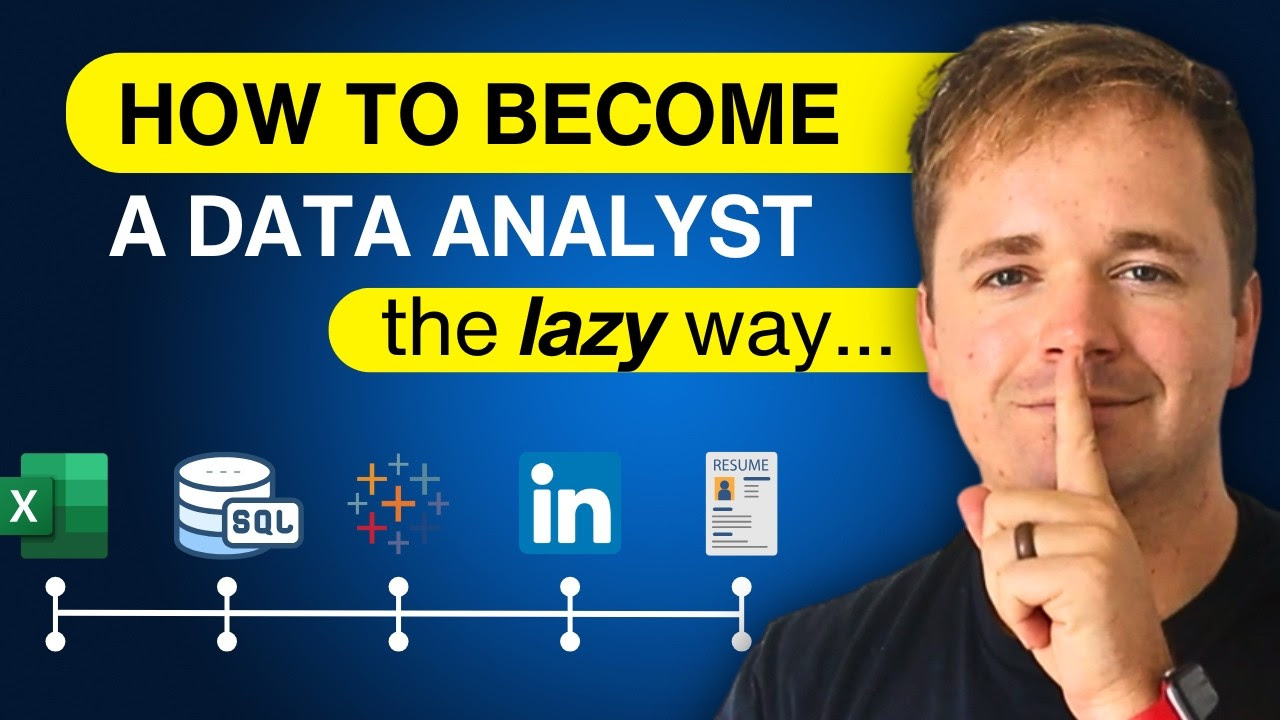
🧩 roadmap to become a data analyst in 2026
Here’s the exact roadmap I’d follow if I had to start all over again and become a data analyst from zero in 2026… (with the least amount of effort needed) 👇
Step 1: Understand the different data roles.
Data analyst isn't the only option. There's business analyst, BI analyst, healthcare analyst, financial analyst, logistics analyst, business intelligence engineer, marketing analyst, pricing analyst, product analyst, etc.
Your past experience might give you a leg up in one of these. Truck drivers make great logistics analysts. Nurses crush it as healthcare analysts.
If you’re only looking at data analyst roles, you’re missing out on a lot of great jobs.
Step 2: Learn Excel, Tableau, and SQL.
There are literally thousands of data skills out there. If you try to learn them all, you'll be 150 years old before you feel "ready" to apply.
So instead, I focus on what I call the low-hanging, tastiest fruit. Tools that are:
Easy to learn
Extremely useful
Actually required by employers
I’ve analyzed 10,000+ job listings. Trust me, focus on Excel, SQL, Tableau.
Step 3: Build projects.
This is how you beat the "I need experience to get a job" trap. Projects are simulated work that prove you can do real work. Find data on Kaggle, analyze it, and publish your results.
That’s how you get recruiters and hiring managers to actually trust you.
Step 4: Create a portfolio.
Your projects need a home. They can’t just be “on your desktop” or in Google Drive. They need an easily accessible, beautiful showcase. It’ll showcase your projects, your resume, your skills, and your contact info. This is called a portfolio. If you don’t have one, landing a data job is nearly impossible.
Step 5: Optimize your LinkedIn and resume.
Your LinkedIn is your business card to the world. Set it to "Open to Work", optimize it like crazy, and watch the recruiters start to come to you. And make sure your resume is ATS-friendly (no columns, no tables, lots of keywords). If not, every application you send is absolutely pointless.
Step 6: Start applying.
You'll never feel "ready" to apply to data jobs. Ever. Instead, do it scared. And don't just apply on LinkedIn. Check company websites and job boards like findadatajob.com. And don’t just apply to 10 jobs. Or 25 jobs. Or even 50 jobs. You’re probably going to need to hit triple digits in today’s economy.
Step 7: Network.
I know. It's uncomfortable. But it works. Tell your friends and family you're looking for a data job. Post on LinkedIn. Ask if anyone knows a data analyst. Most jobs are filled through connections, not applications. If you don’t network, everything is 10x harder.
Step 8: Prep for interviews.
Interviews are important, but only when you land them. Don’t worry about interviews until you land a few.
Once you do, interviews come in two flavors: Technical (Can you solve this SQL problem?) and Behavioral (Tell me about a time you dealt with a difficult co-worker). Practice both. For the behavioral ones, use the STAR method: Situation, Task, Action, Result.
Don’t overthink. Follow this plan.
This is the exact 8-step plan I’d follow if I had to start from scratch all over again.
I think it’s the fastest, easiest way to landing your first data job.
Don’t waste your time coming up with your own roadmap from scratch, just follow this one. Don’t over think it here. I’ve been where you’re at. I’ve coached 947 people just like you. I’ve seen this work. Take my word for it.
Is it easy? No. Is it worth it? yes.
If you're still feeling lost or want support following this roadmap step-by-step, this is exactly what I teach inside the Data Analytics Accelerator.
It's a 10 week program where we learn Excel, SQL, and Tableau by building real projects. You'll get resume reviews, portfolio help, and a whole community of people going through the same thing.