
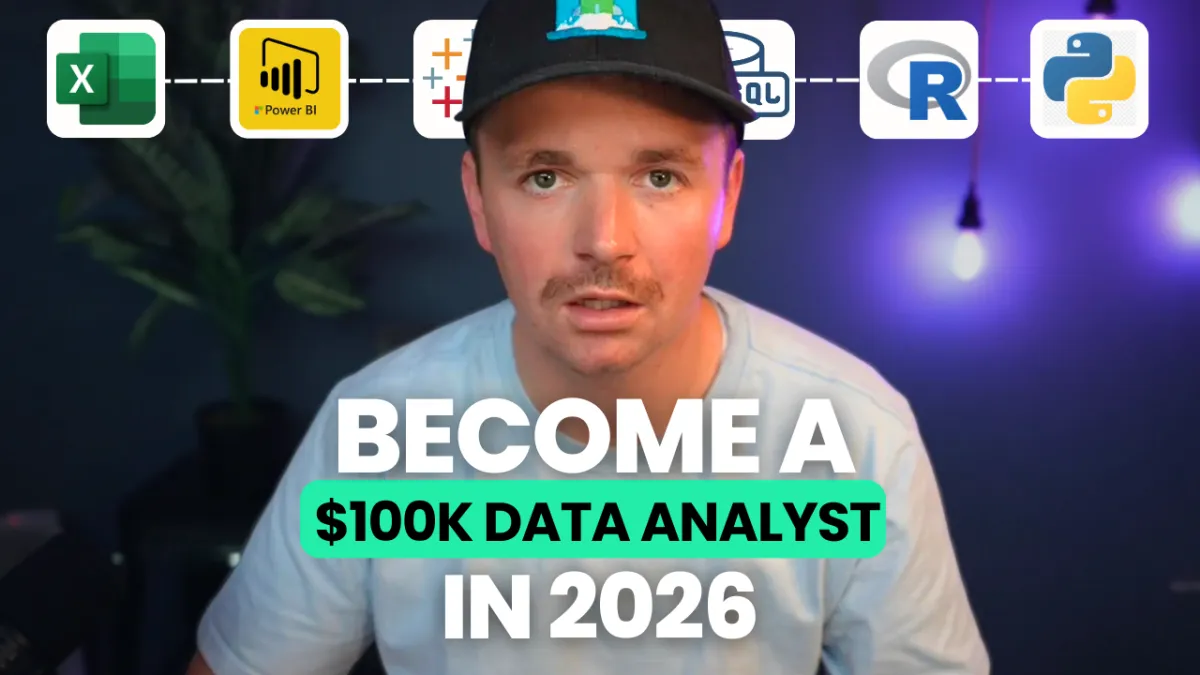
🚀 If I Wanted To Become a Data Analyst in 2026, I'd Follow This Plan
This may be a surprise to you, but I have zero data certificates. Not one.
And I've landed every data job I've ever had without one.
It’s the truth! I’m not lying!
A lot of people ask me what cert they should get: Google or IBM or Meta?
My answer is I don’t like any of them.
None of them carry weight in industry.
If I were starting over in 2026, I'd do the same thing. The market is crowded.
Certificates make you blend in, not stand out.
So here's what I'd do... and here’s what many of you may be doing wrong…
(Caveat, now I do have a Master’s in Analytics - but I got it AFTER I landed all my corporate jobs and even after I started my own data analytics consulting business in 2021 - so my point still stands - you don’t need them).
You’re trying to learn every data skill
Python, R, machine learning, statistics, three different BI tools, data engineering… the list never ends. You wake up one day and you're 89 years old, still watching tutorial videos.
I call this "tutorial hell." It's the fastest way to stay broke and unemployed.
The truth is, you only need three things to get your first data analyst job.
Excel. One BI tool (Tableau OR Power BI). And SQL.
That's it. That's the whole stack.
Everything else? Put it on a shelf. You're not a data scientist. You're trying to become a data analyst. You don’t have to be an expert in every single skill.
It’s impossible.
But knowing these tools isn't enough. Anyone can click buttons. My grandma could watch a YouTube video and make a bar chart. (Okay, they’re both passed so probably not - but you get the point!)
What gets you hired is learning to think like an analyst.
And that’s harder to do.
Most online certs skip this part. Ignore it. They just tell you HOW to do stuff - now why or when.
I’m actually in the process of going through my entire bootcamp and adding new sections to each module on THINKING like an analyst.
Should be useful (and fun).
Skills Alone Won't Get You Hired
Okay, let's say you learned Excel, SQL, and Tableau. Great. You're ahead of most people.
But the truth is, no one cares. You are stuck in the ‘Cycle of Doom.’
Can't get a data job because you don't have data experience. Can't get data experience because you don't have a data job.
Impossible to escape right?
But you don't need experience. You need trust.
You need to make hiring managers feel safe picking you.
Think about it. They don't know you. They've never met you. All they have is a PDF with your name on it and 200 other PDFs that look exactly the same.
So how do you build trust?
Three ways:
1. Your portfolio
This is your proof. Not a certificate. Not a "I completed 40 hours of training" PDF. Real projects that show you can do the work.
Pick a dataset. Clean it. Analyze it. Build a dashboard. Write up what you found. Do this 3 to 5 times and you're already ahead of 95% of applicants.
2. Your resume and LinkedIn
Most resumes suck.
Especially if you’re switching careers. It’s hard to make your bullets exciting and relevant.
Your resume needs to show skills & results, not boring responsibilities.
Same with LinkedIn. Make it crystal clear what you do, what problems you solve, and what you're working on right now.
3. Your network (yes, really)
I know. Networking feels awkward. But it's not about being fake or begging for jobs.
It's about having real conversations with real people.
Send a cold message to someone in data. Don't ask for a job. Just ask them about their day. What tools do they use? What's hard about their job?
Most people never do this. Which is why it works so well when you do.
If you can get a referral from someone inside the company? You just jumped to the front of the line. That's the power of trust.
You're Searching for the Wrong Jobs
Here's another thing most people miss: they only apply to jobs with "Data Analyst" in the title.
Big mistake.
There are 40+ other job titles that are basically data analyst jobs in disguise:
Business Intelligence Analyst
Financial Analyst
Pricing Analyst
Marketing Analyst
Product Analyst
The list goes on.
These roles get WAY fewer applications because everyone else only searches "Data Analyst". But the work is the same. The pay is the same. Sometimes it's even better.
Start searching for these roles and watch your opportunities multiply.
What You Should Do Right Now
Pause.
What has stood out to you the most reading this?
Was it learning skills?
→ Pick one of the three tools (Excel, SQL, or a BI tool) and start a small project.
→ Find a dataset that interests you. Maybe it's sports stats. Maybe it's your own spending habits. Maybe it's real estate prices in your city. Just pick something and start analyzing it.
Was it networking?
→ Update your LinkedIn with what you're learning right now. Don't wait until you're "done." Share the journey.
→ Send one cold message to someone who works in data. Ask them one question about their day. That's it. No job begging. Just curiosity.
Was it all of it? LOL
→ Don’t worry - you’re not alone.
If you really want to take this seriously and accelerate your pivot, consider my Data Analytics Accelerator. We’ll walk you through all of this.
The market is crowded in 2026. But not many people have real projects, a strong portfolio, and the guts to reach out
You will if you follow what I say.
Be that person.