how to become a data analyst in 2027
The Early Black Friday Cohort of The Accelerator starts this Monday, November 9th. Join our bootcamp today so you can land a data job in 2027. This is the biggest discount we offer all year with 9 different bonuses.
We have 57 days until 2027
If I suddenly woke up today and was no longer a data analyst, here's exactly what I'd do to become one again as quickly as possible.
I call it the SPN method. Skills, projects, networking. You need all 3.
And look — I'm lazy. I'm impatient. So this whole thing is designed to get the most results with the least amount of effort.
Let's go.
Step 1: Stop focusing on learning data analytics skills
Yup. You read that right.
Don't get me wrong. The skills matter. You need them. But there's a minimum threshold to be qualified for an entry-level job, and learning more tools or getting better at a tool is probably not what's holding you back.
How do you know it's not holding you back? Until you've actually failed multiple technical interviews, most hiring managers can't even gauge how skilled you are at SQL or Excel.
So what is holding you back? Steps two through five.
But you do need some tools. The S part of SPN.
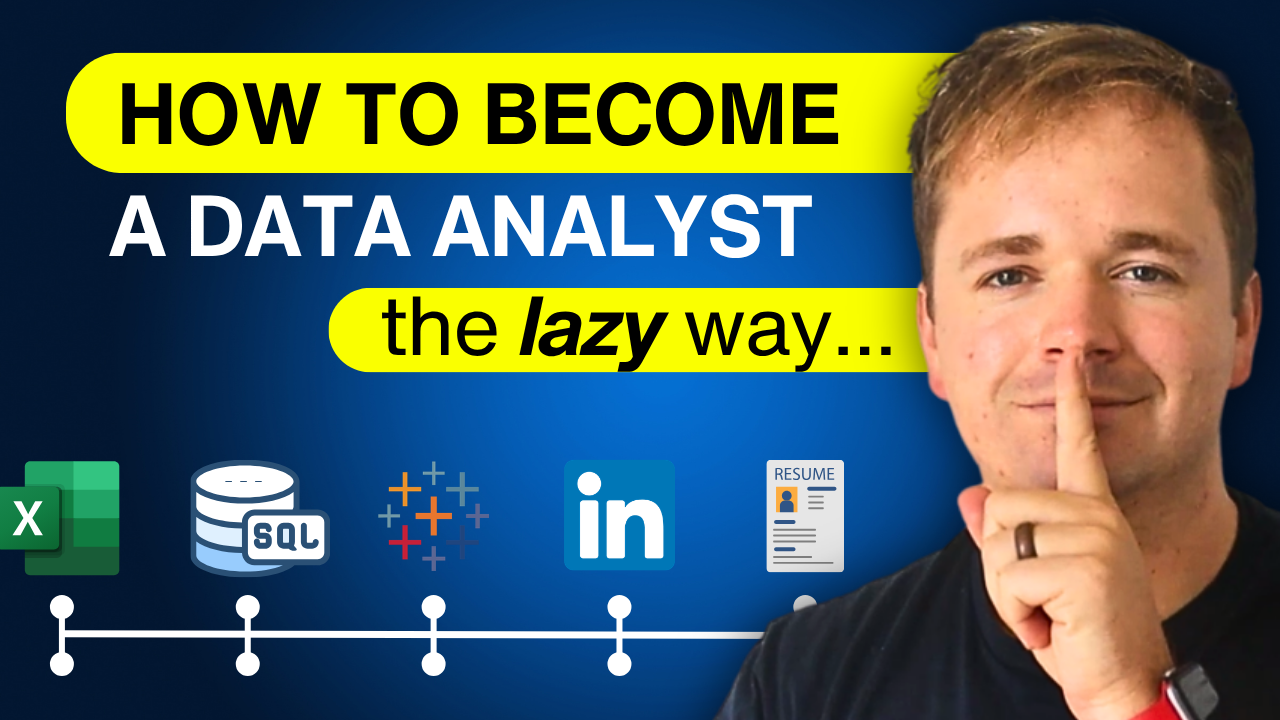
Here's what I'd focus on, in exactly this order: Excel, Tableau, and SQL.
Every Turtle Swims. That's the acronym. (You can swap Power BI for Tableau if you want. Then it's Every Penguin Swims.)
In Excel, you should know formulas, sorting, filtering, pivot tables, and Xlookups.
In SQL, you should know select, where, from, group by, all the little operators, and up to having.
In a BI tool, you should feel comfortable building a bar chart, a line chart, a scatter chart, and making KPIs.
That's it. That's all you really need to get started.
If you're learning Python or R or AWS or any cloud stuff before you land your first data job, put it on the shelf. The only exception is learning how to use AI to analyze data (tools like Copilot or Claude).
Eighty percent of data job listings still don't mention AI, but it's becoming more important. So learn the fundamentals, but also learn how to analyze data with AI.
Every turtle swims plus some AI.
Step 2: Break the cycle of doom
Let's say I learn Excel, Tableau, and SQL to a decent level. I still have a big problem.
How the heck am I gonna convince a hiring manager or recruiter to be interested in me when I have zero years of experience?
Every job description, even the junior ones, asks for one year, three years, five years. I have a big fat zero.
I call this the circle of doom. "I can't land a data job because I don't have data experience because I can't land a data job."
It sucks.
So how do I get out? I give myself my own experience.
Three ways to do that 👇
Projects. Tangible evidence for hiring managers that you can actually do the things your resume says you can do. You take a dataset, you analyze it as if you were a data analyst, and you publish your analysis somewhere for them to see. It's practice work. And it's a great way to learn because you're learning while you're building the proof.
Internships. A very applicable real-world project for an actual organization, but you're probably not getting paid for it. They're harder to find. (I let all my boot camp students do an internship for me and my company, but you could probably find one in your neighborhood or maybe your cousin runs a business.)
Experience shifting. You take your prior experience and reframe it as data experience. Change your prior work roles and titles and bullet points on your resume and shift them into a more data-y context.
For example, if I was a customer service associate in the past, I could shift that title to customer service analyst on my resume. If I had a bullet point that said "answered customer complaint calls," I could shift it to "logged customer feedback in Excel."
I would never lie. But most experiences can be shifted at least slightly to favor yourself. There are so many roles in the data world that aren't data analyst titles but are really just data analysts disguised as something else. Marketing analyst, business analyst, financial analyst, operations analyst, healthcare analyst. These are all just data analyst roles in different industries.
Your prior experience is probably partially data experience. It just needs to be shifted on paper and phrased the right way.
So personally, I'd learn Excel, Tableau, and SQL by doing projects with real-world datasets. I'd do an internship with my boot camp or a local organization. And I'd shift my previous chemical lab experience to be more data-y.
All of a sudden, I have data experience on my resume and on my LinkedIn.
Step 3: Build a home base
If I made these projects, that still wouldn't be enough because no one would know about them.
I need to publish them. I need to give them a public home. That's a portfolio.
You can do multiple projects and host them all on one portfolio.
My favorite rec's are GitHub Pages (GitHub's portfolio product), or any website builder like Square, Wix, Carrd. You could even use your own LinkedIn profile with their built-in project section. Or better yet, use their articles plus a featured section and host it on LinkedIn.
I actually have my own platform called MyDataFolio that we built specifically for data analysts. There's pros and cons to every platform, so we built our own to make it the absolute best place to build your data portfolio.
Personally, I'd choose My Datafolio and build my portfolio there.
Once I have this portfolio live, I need to make sure I have it linked on my resume and on my LinkedIn so people can actually see it.
Step 4: Hack my resume and hack my LinkedIn
I would literally think of it as hacking. I'm hacking my resume and my LinkedIn to be the most ATS-optimized I possibly could.
So many people wait to update their resume and LinkedIn until they feel ready, until they've learned everything.
Newsflash: you will never feel ready. You will never learn everything.
I still don't feel ready. I've been in this field for ten-plus years.
It's important to update your resume and LinkedIn early because these, along with your portfolio, are really the only things being used to judge you as a data analyst, to judge you as a job candidate.
They're basically your professional business cards to the world. If these aren't optimized, you will struggle to land an interview, even if you're a great candidate.
On the other hand, if you're an average candidate but you have an amazingly optimized LinkedIn and resume, you're gonna land more interviews, that's gonna lead to more offers, and it's gonna lead to a higher salary.
So how do you optimize them? By making some changes to trick the applicant tracking system — the ATS — into thinking I'm a better fit for the role than maybe I am.
Most ATS's are pretty dang dumb most of the time. They're really just looking for the words on the job description and the words on your resume or LinkedIn, and they're like, "How many words are the same? How good of a match is this person based off the word match?"
It's not quite that simple, but it's a good way to think about it.
If I wanted to apply to a data analyst job that requires Excel, Tableau, and SQL, and I don't have the term "data analyst" on my resume and I don't have the words Excel, Tableau, or SQL on my resume, I literally have no shot to get past the applicant tracking system.
On the other hand, the more times I have those key terms on my resume or LinkedIn, the better chance I have of passing it.
This is a technique called keyword stuffing, and it is possible to go overboard, but I rarely see it from people. The majority of aspiring data analysts under-stuff key phrases like the title and the skills they need to know for the job description.
Personally, I will keyword stuff the heck out of my LinkedIn and my resume. Doing some of that experience shifting makes this process a little bit easier and more natural.
Step 5: Take interview actions
Take actions that lead to interviews.
Mostly, that means apply to jobs.
This probably won't be a shock, but internalize it: if you don't apply to jobs, you will not get interviews. If you don't get interviews, you will not land a job.
I see so many aspiring data analysts get stuck here. They're so analysis paralysis in their own head, so much imposter syndrome, that they've already learned a lot, maybe even built some projects, but they can never get the confidence to feel ready to apply to jobs.
Look — I get it. Applying to jobs is really scary. It's frustrating. It sucks. It's annoying.
But you know what else is sucky and frustrating and annoying? Staying stuck in your current situation.
Personally, I will be applying to jobs even if I do not feel ready, even if it's scary.
I'll be using LinkedIn Jobs, but I'll also be trying other job boards like Indeed and FindaDataJob.com.
But applying for jobs is not the only action that leads to interviews. It might not even be the best action to take.
There's another action I could take that's probably equally scary, frustrating, and annoying, but it will get twenty times the results.
Networking.
Networking basically means talking to humans. Meeting new people. Talking to old connections.
I won't sugarcoat this — it will be annoying. But it will lead to so many results you can't even believe it.
I'd personally do "The Phone Book" Method. Pull out my phone, go through every contact in there and send them a message. A simple, "hey, how's work going?" would be enough to get started
Rinse & Repeat
If I do these 5 steps, I'm bound to get interviews and offers. And so are you.
Save this. Print it out. Follow it to a T.
Good things will happen.
If you'd like to do these 5 steps with friends and a mentor who cares about you, maybe consider joining us in The Accelerator.
We are having the biggest sale of the year right now.
I'll teach you everything you need to know plus more.
LATEST EPISODE

How I Would Become a Data Analyst in 2027 (if I had to start over again)
DATA JOBS OF THE WEEK
- Financial Analyst II — TRILLIUM HEALTH RESOURCES
- Business Analyst I (Remote) — Businessolver
- Data Analyst - Customer Analytics — Granicus
UPCOMING EVENTS
November Cohort Kickoff of The Accelerator
Monday, Nov 9 · 5pm MT
Our next Accelerator cohort starts November 9. We'd love to have you.
⚠️ Why DIY-ing your data career might be dangeorus
This is the story of how I screwed up my expensive road bike...and the warning for your data journey.
So I like to road bike. And I have a decently nice one - cost me $4,000. And recently, the front brake stopped working.
I'm very skilled at technology at computers...but not so much mechanical stuff - but I want to learn. I had a big ride coming up with my high school best friend up Big Cottonwood Canyon.
My friend's bike needed some work. He decided to take it into a shop and let an expert fix it. Not me. I wanted to DIY my bike brake - even though I didn't really know how. I didn't want to drive 20 minutes to the shop, to pay for the $150 tune up, and drive 20 minutes back, and then go back and pick it up, when I could do it for free at home.
Where it started to go wrong...
Of course I procrastinated to the day before our big ride. I just didn't make for it. It was a priority in my heart, but clearly not enough to make time for my schedule.
I turned the bike over & start to remove the wheel and the brake...but it got stuck. To the point where I couldn't take it off at all. And I really didn't know how to get it back on. The ride was in 24 hours.
Uh, oh.
Of course no shop has that fast of availability, so I sprinted to Facebook Marketplace to find a local guy who could fix it for me ASAP.
Found a guy who said he could fix it that night.
Drove 30 minutes to this guys' house...he said it would be 30 minutes so I waited...well 3 hours later, it still wasn't fixed.
Finally I said I had to go, I paid him the 3 hours of labor. And decided my fate...
I had to cancel the ride
And turns out, the FB dude put the wrong brake fluid in.
Now, I'm going to have to take it to the original shop and it's probably gonna cost double to fix it, on top of all the wasted time and money I've already spent.
Moral of the story?
DIY-ing can feel "affordable" and "cool", but at what cost? At what point, are you actually costing you and your family money by trying to do it yourself instead of letting an expert do it?
I know I won't be fixing my bike again...at least without attending a bike fixing clinic first. YouTube and AI only got me in a huge mess.
Nope, the experts will be helping me with my bike for now. It's actually cheaper and faster that way.
Let me be your bike mechanic
Sure. The Accelerator is more expensive than The Google Data Analytics Certificate or watching free YouTube...but are you actually making progress? Are you doing the right things? Or are you like me - just making a bit of a mess?
And what is that opportunity cost? Is it worth it? Of course, only you can know the answer to that. I'm not telling you one way or the other - just warning you of my experience.
And right now, we are having a massive sale. So if you've been thinking about having some actual, real expert's help, maybe this is your sign to bite the bullet.
As always, thanks for reading :)